Introduction
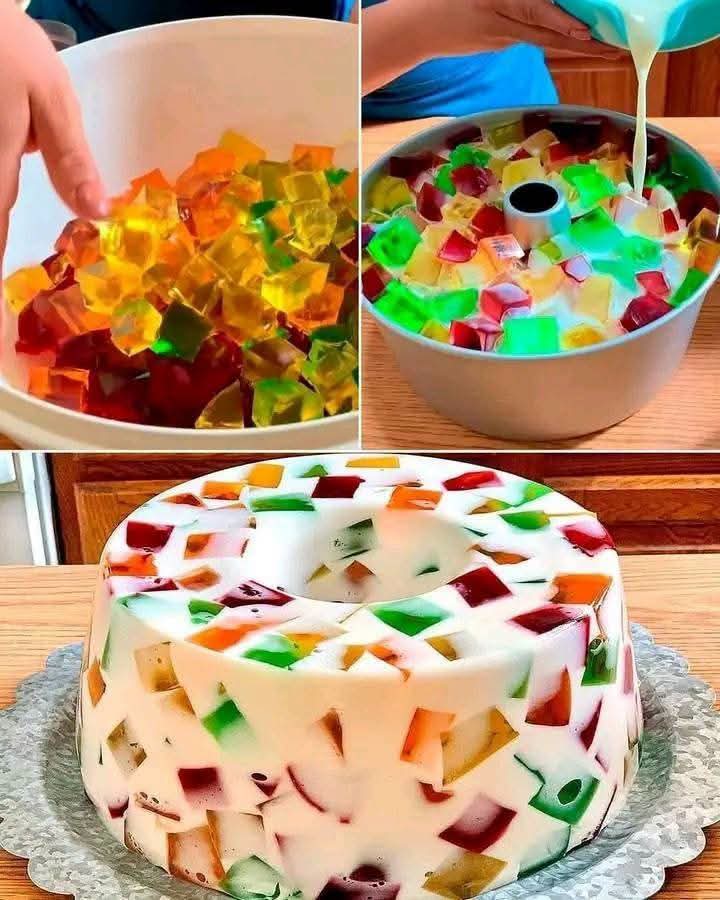
Broken Glass Jelly Cake is a colorful, no-bake dessert made from cubes of fruit-flavored gelatin suspended in a creamy white jelly mixture. When sliced, the bright red, green, orange, and yellow pieces resemble stained glass or colorful mosaic tiles. It is especially attractive for birthdays, holidays, family gatherings, and summer celebrations. The dessert is also known as Stained Glass Jelly, Broken Glass Jello, Mosaic Jelly, or Cathedral Window Jelly.
Origin
The exact origin of Broken Glass Jelly is difficult to establish because similar gelatin desserts developed in several countries. A particularly well-known version is Gelatina de Mosaico, associated with Mexico and Brazil, while the Philippines has a popular version called Cathedral Window Jelly. Similar recipes also became popular in mid-20th-century home cooking because gelatin was inexpensive, convenient, and easy to turn into colorful desserts.
Rather than belonging exclusively to one country, the dessert is best understood as part of a broader international tradition of creative gelatin desserts.
Cultural Significance
This dessert is strongly associated with celebration and sharing. Its bright colors make it a popular choice for parties, family gatherings, festive tables, and children’s celebrations. In the Philippines, the name Cathedral Window Jelly refers to the resemblance between the colorful gelatin pieces and stained-glass windows.
Its appeal also comes from its nostalgic character: it is inexpensive, can be prepared ahead of time, and looks much more elaborate than the simple ingredients suggest.
Ingredients – Quantity
Serves: 10–12
Preparation: 30 minutes
Chilling: 6–8 hours, preferably overnight
Difficulty: Easy
For the colorful jelly cubes
- 4 packets flavored gelatin, approximately 80–85 g each, in different colors and flavors
- 4 cups boiling water, 1 cup per flavor
For the creamy jelly
- 1 can sweetened condensed milk, about 390–400 g
- 1 can evaporated milk, about 350–400 ml
- 400 ml coconut milk
- 28 g unflavored gelatin
- 120 ml cold water
- 120 ml hot water
- ½ teaspoon vanilla extract
- A small pinch of salt
Using a reduced amount of water for the flavored gelatin helps produce firm cubes that hold their shape when mixed into the creamy base. This is a common technique in stained-glass jelly recipes.
Optional Additions
You can easily customize the dessert with:
- Fresh mango or strawberries
- Small pineapple pieces
- Coconut flakes
- Fruit-flavored gelatin combinations
- Lemon or lime zest
- Almond or coconut extract
- Greek yogurt for a tangier creamy layer
- Reduced-sugar gelatin for a lighter version
- Agar-agar instead of gelatin for a vegetarian-style variation, depending on the recipe and setting requirements
For the most beautiful result, choose three to five contrasting colors rather than using several shades that look similar.
Tips for Success
- Use less water for the colored gelatin. This creates firm cubes that will not easily break apart.
- Allow the colored jelly to become completely firm before cutting it.
- Cut the cubes into relatively similar sizes so they distribute evenly throughout the cake.
- Let the creamy mixture cool slightly before pouring it over the jelly cubes. If it is very hot, it can soften or partially melt them.
- Do not overmix. Gently fold the cubes into the creamy mixture.
- Lightly grease the mold or use a thin layer of neutral oil to make unmolding easier.
- Chill the cake for at least 6 hours, preferably overnight.
- To release it easily, briefly dip the outside of the mold in warm water before turning it onto a serving plate.
- Use a sharp knife and wipe it between cuts for clean, attractive slices.
- Keep the cake refrigerated until serving.
Instructions
1. Prepare the colored gelatin
Prepare each flavor of gelatin separately using 1 cup of boiling water instead of the larger amount normally recommended on many packages.
Pour each flavor into a separate shallow container and refrigerate until completely firm, usually 3–4 hours.
2. Cut the jelly
Remove the firm gelatin from the refrigerator and cut each flavor into small cubes.
Gently combine the cubes in a large bowl, being careful not to crush them.
3. Prepare the gelatin base
Sprinkle the unflavored gelatin over the cold water and let it bloom for about 5 minutes.
Add the hot water and stir until completely dissolved.
4. Make the creamy mixture
In another bowl, whisk together the condensed milk, evaporated milk, coconut milk, vanilla extract, and salt.
Slowly add the dissolved gelatin and whisk until smooth.
Allow the mixture to cool until it is cool but still liquid.
5. Assemble
Lightly grease a Bundt or ring-shaped mold.
Arrange some of the colorful jelly cubes inside the mold. Pour in a little of the creamy mixture.
Continue alternating between jelly cubes and the creamy mixture until the mold is full.
Gently tap the mold on the counter to remove large air pockets.
6. Chill
Cover the mold and refrigerate for 6–8 hours, or preferably overnight, until completely set.
7. Unmold and serve
Run a thin knife gently around the edges if necessary. Briefly dip the outside of the mold in warm water.
Place a serving plate on top of the mold and carefully turn it upside down.
Slice and serve chilled.
Description
The finished Broken Glass Jelly Cake has a soft, creamy, slightly milky texture surrounding firm, fruity gelatin cubes. Every slice reveals a different colorful pattern, making the dessert look like a piece of stained glass.
The creamy base balances the sweetness and fruitiness of the colored gelatin, while the different textures make every bite playful and refreshing.
Nutritional Information
Approximate values will vary according to the gelatin brands and quantities used.
Estimated per serving, assuming 12 servings:
| Nutrient | Approximate amount |
|---|---|
| Calories | 180–230 kcal |
| Carbohydrates | 30–38 g |
| Sugars | 25–32 g |
| Protein | 4–6 g |
| Fat | 5–8 g |
| Saturated fat | 3–5 g |
| Fiber | 0–1 g |
| Sodium | 80–150 mg |
Because this dessert contains sweetened condensed milk and flavored gelatin, it is best enjoyed as an occasional dessert rather than an everyday snack.
Conclusion
Broken Glass Jelly Cake proves that a simple combination of gelatin and a creamy base can become an impressive centerpiece. Its colorful appearance, refreshing texture, and make-ahead convenience make it ideal for celebrations and family gatherings.
The recipe is also highly adaptable: you can change the colors, flavors, mold, and creamy base to create a different version every time.
Recommendation
For the most visually impressive result, I recommend using four contrasting fruit flavors such as strawberry, orange, lime, and blueberry. A Bundt or ring mold gives the dessert the beautiful stained-glass appearance shown in the image.
For parties, prepare it the night before and keep it refrigerated until serving. This gives the creamy layer enough time to become firm and makes slicing much easier.
Embracing Healthful Indulgence
A healthier version can be created without losing the dessert’s signature appearance. Choose reduced-sugar gelatin, use a lighter milk base, reduce the amount of condensed milk, and incorporate naturally sweet fruit such as mango, berries, or pineapple.